Blogger Widgets
Showing posts with label Guest Post. Show all posts

Sunday, December 29, 2013

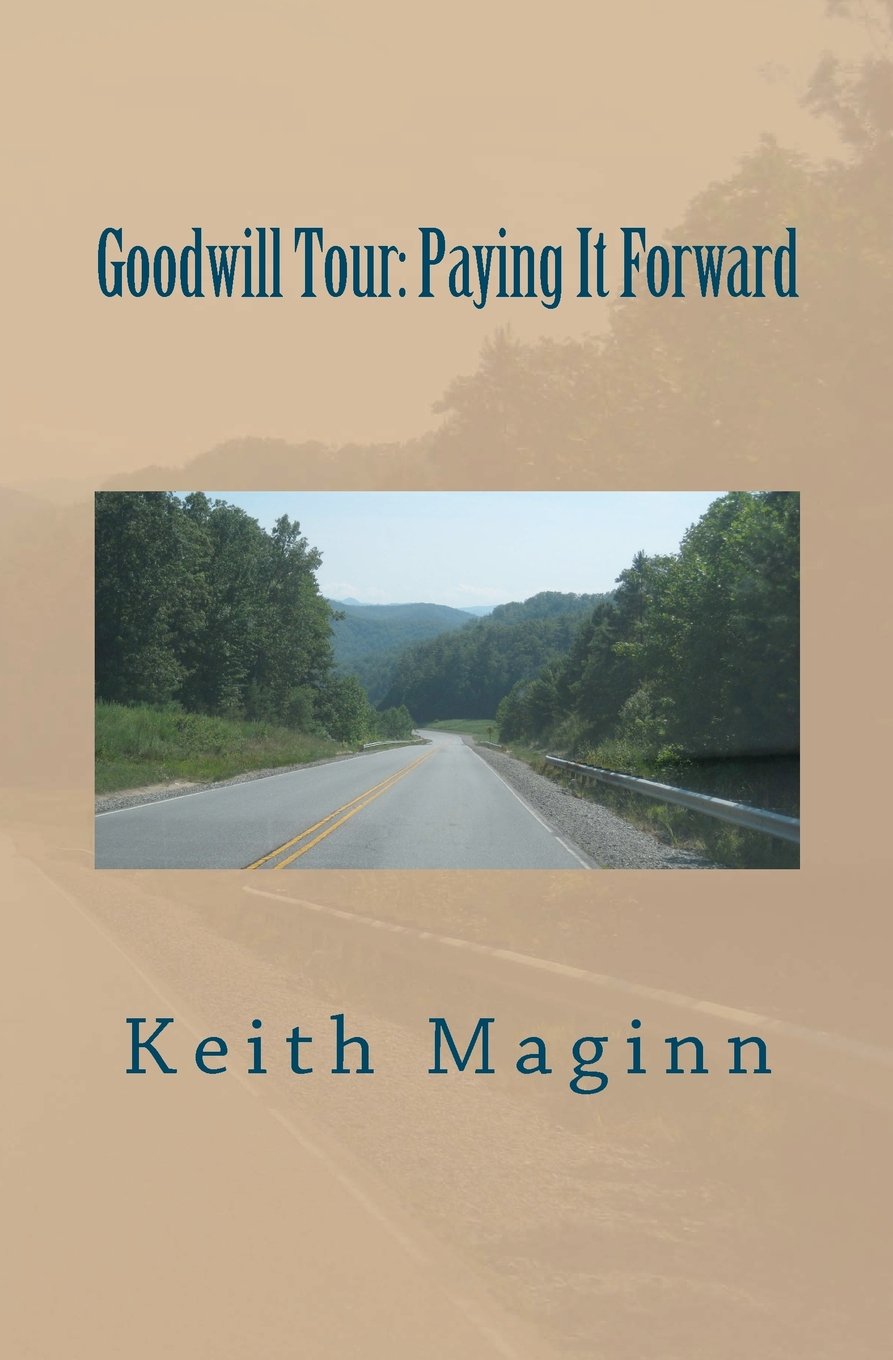
Guest Post & Giveaway: Goodwill Tour:Paying It Forward by Keith Maginn

Title: Goodwill Tour: Paying It Forward 
Author: Keith Maginn
Publication: January 4, 2013

Amazon|B&N|Goodreads

Synopsis: 
In mid-July of 2011, Keith Maginn, and his friend, Emily, set off from Cincinnati, Ohio, on a 3,000-mile road-trip through several southeastern states. The pair stopped in Memphis, New Orleans, Savannah, Charleston, Asheville and smaller towns in between. Goodwill Tour: Paying It Forward is a travelogue detailing a philanthropic experiment in this incredible country the two call home. What makes their trip unique—and Maginn’s book fresh—is that sightseeing wasn't their sole purpose. Emily and Keith were determined to spread kindness as they worked to make a difference in the lives of others along the way. They gave their own money to hand-picked strangers, who then had to pay the money forward to someone else. Goodwill Tour is the narrative of the places Emily and Keith visited and the people they met on their journey. It is an ode to the United States and, even more, a tribute to its people. From Beale Street to Bourbon Street and Graceland to the Biltmore Estate, from feeding the needy in downtown Charleston to brainstorming ideas with a female Buddhist monk to help abused teens and high school dropouts in North Carolina, readers will enjoy riding shotgun on the trip as they relive the experience of these life-altering events, and contemplate how people changed as a result. Supplemented by quotes from Jon Krakauer’s Into the Wild, Douglas Brinkley’s The Majic Bus and Try Giving Yourself Away by David Dunn, this book satisfies two longings at once: to have a fun, interesting journey and to motivate readers to have an impact on the people around them. With so much negativity in the news and so many struggling in a beaten-down economy, the public is crying out for a feel-good, transformative book like Goodwill Tour. Many have driven around the country for adventure; countless others serve their community. Maginn and his friend set out to accomplish both at once. Their pay-it-forward mission will touch and inspire readers to take the trip that they've always dreamed of or to have a positive effect in the life of a loved one, an acquaintance, or even a complete stranger.

Today it is my pleasure to introduce Keith Maginn to our readers. Keith is sharing his second book with us. With that I hand the floor over to Keith. 


My name is Keith Maginn and I released my second book, Goodwill Tour: Paying It Forward in January of 2013. GWT is a travelogue about a journey that I went on with my friend in mid-July of 2011. Emily and I set off from Cincinnati, Ohio on a 3,000-mile road-trip through the southeastern United States. We gave our own money to hand-picked strangers that we met along the way, with the stipulation that they had to pay the money forward to someone else. Goodwill Tour recounts how Emily and I tried to spread kindness and make a difference in the lives of others while having a once-in-a-lifetime journey.

The idea for the trip actually started out as a joke. Emily and I met through my memoir, Turning This Thing Around. A friendship developed over time and we started half-seriously daydreaming about doing a tour to sell my books. The two of us brainstormed how we could combine having an adventure with doing something philanthropic. Emily had read Bill Clinton’s book Giving and was well aware of the “Pay-it-Forward” cause. Ultimately, she came up with the idea to go out on the road, meet deserving strangers and give them money that they had to give to someone else. Meanwhile, I would be taking notes along the way that I would turn into a book.

The whole trip came about quickly and we didn’t have time to plan much of anything. Emily and I only had a 15-day window for our trip, so the route had to be within driving distance of Cincinnati, our hometown. We knew the Southeastern U.S. route would put us in the Deep South in the middle of a very hot summer, but that course would allow us to visit more places that we had never been previously. Just a few days before we were going to leave, Emily and I decided to go to Memphis, Tennessee - New Orleans, Louisiana - Savannah, Georgia - Charleston, South Carolina - Asheville, North Carolina…and many towns in between.

Other than a loose idea of destinations, Emily and I decided we would just take a leap of faith and trust our instincts. We wanted to put ourselves into positions to meet deserving people. In some cases we were able to work alongside volunteers, at a soup kitchen for example, and other times meeting our donation recipients was more serendipitous. Believe it or not, giving money to strangers was harder than we expected!

The people that we chose ranged from a nun to a mother of three young children to a monk. As you can imagine, all were quite surprised when complete strangers handed them cash. What struck me the most about these people is that they kept thanking us for what we were doing, while they were the ones really making a difference—Emily and I were travelling around for a few weeks, while the people we met worked or volunteered to help others on a daily basis for little or no credit.

Stepping off of the trolley in our first stop (Memphis, Tennessee) was when it first hit me—we were actually going through with this crazy idea! Emily and I had the next several days to do whatever we wanted. No deadlines, no 9-5 job, just a goal to have fun and to touch some lives.

Giving away the first donation to a special young woman in Memphis made us realize that things might work out after all. She was genuinely grateful and all three of us were in tears. (The first interaction also gave us a false sense of how smooth the trip and the giving would be, as things were not that easy the rest of the trip!)

Emily and I easily could have backed out of this trip, could have put it off for “another time”…a time that likely would never come. I am glad that we took a chance. No one can ever take that away from us. In the words of John F. Kennedy: “There are risks and costs to a program of action. But they are far less than the long range risks and costs of comfortable inaction.”

You only live once. You don’t want to have regrets the rest of your life because you didn’t go after something you were passionate about. When my aunt found out that Emily and I were going on this journey, she said “One of my regrets is that I didn’t do once-in-a-lifetime things when I was young and unencumbered.” You will never know unless you step out of your comfort zone and follow what your heart is telling you to do. If you go forward, you might be surprised how things just seem to work in your favor. I hope Goodwill Tour: Paying It Forward inspires others to take their dream trip and/or to make a difference in the lives of others.

[As an unknown, independent author, I am grateful to Wanted Readers for giving me a platform to help spread my message. I also appreciate people like you for reading my story. I would love to connect with you on Twitter (@Keith_Maginn) or at my website (keithmaginn.com). Thank you and all the best!!]

Giveaway: This giveaway is for one (1) ebook copy of Goodwill Tour:Paying It Forward by Keith Maginn. Please use the rafflecopter form below to enter. a Rafflecopter giveaway

Monday, April 22, 2013

Tour:Terminus by Joshua Graham


About the Book:
How far must an angel fall to find his destiny?

Having witnessed one too many senseless deaths, Nikolai, a disillusioned Reaper 3rd Class, resigns his commission with the Angel Forces after a tedious century of gathering souls.

Immediately, another division recruits him with the promise of a more rewarding career, and issues his initial assignments: To bring down a few very dangerous threats to the human race.  In the process, Nikolai falls in love with one of his targets—Hope Matheson, a woman who will lead thousands astray.

Caught between conflicting agendas, Nikolai chooses to “fall” from his celestial state and become mortal in order to circumvent angel law and be with her.  But for angels and humans alike, things are not always as they appear.  Still a target, the threat against Hope’s life intensifies.

Now, in order to save her, Nikolai must rally the last remnants of his failing supernatural abilities to prevent her assassination, as well as the destruction of an entire city by a nuclear terrorist strike.

But his time and power are running out…

Terminus is a perspective-altering saga that delves into ageless themes of redemption, destiny, and the eternal power of love.


First Chapter Reveal:

PRELUDE
THREE SECONDS.  THAT WAS ALL.

The man in the black leather jacket had looked down for just three seconds to read a text message on his phone.  And in the interim, his five-year-old Houdini of a stepdaughter Chloe had unstrapped herself, climbed out of her car seat, and slipped out of sight—nowhere near the doorway of the office where he was to meet his contact.

Just three lousy seconds!

His mouth went dry.

He scanned the streets, sidewalk, between cars, to the left then right then a quick three-sixty.  Despite the thorough sweep, which took all of two seconds, he didn’t see her.

“Chloe!”

She didn’t answer, but he spotted her.  Way down the street, her auburn pigtails bouncing with each step.

“Chloe!  Wait!”  He slammed shut the back door of his Focus.  Didn’t bother to lock it.Ran up the sidewalk—fast.  But the little stinker was fixated on a black cat luring her across the imaginary border that separated thegentrified arts district of Carleton Village and the slums of East Brentwood.

The cat bolted around the corner at the sound of the man’s agitated shouts.  Both hands outstretched, Chloe giggled and ran even faster.

“Kitty!”

He nearly tripped over an uneven seam in the sidewalk as he ran, his heart going faster than his feet.

A pair of SDPD squad cars with flashing red and blue beacons raced past Birch and came to a screeching halt somewhere around the corner of Lamont.

The little girl turned the same corner and vanished behind the red bricks of the apartment building.  Straight onto Lamont.

“Stop, Chloe!”  He’d gained but was still several steps behind.

The sound of a policeman shouting filled his head.  Could things get any worse?  He ran even harder.

It all happened within a matter of seconds.

Three lousy seconds.

That's what it took for him to round the corner and make out the figure fleeing the pimped-out Honda Civic that had crashed into a hydrant.  The gunman shot at the cops, who now stood behind the open doors of their angled cars.

The man in the black leather jacket leapt at Chloe.

“Get down!”

Over his shout, the shouts of the police, the screams of frightened pedestrians, came a deafening pop! whose impact toppled him.

Chloe screamed.

A sudden chill overtook him as a crimson pool expanded around his face, now planted on the cold concrete sidewalk.  He tried to speak, stretched his fingers towards Chloe.  Felt nothing but the cold pumping though his entire body.

Life didn’t flash before his eyes.

He heard more gunshots.

The last thing he saw was Chloe lurching back, her pigtails flailing to the side.  As though in slow motion, she was falling.

Falling...

He never saw her hit the ground.


1

AS A REAPER OF THE THIRD LEGION, Nikolai—Nick, as he preferred to be called these days—had attended to more human deaths over the last thousand years than he cared to.  Countless lives and memories snuffed out like the wick of a candle.  It had all become routine, meaningless.

Vanitasvanitatum.

The ability to traverse the entire planet in the blink of a human eye had long grown commonplace, its charm lost somewhere between King Malcolm II’s victory in The Battle of Mortlach and Guttenberg’s invention of moveable type.  These days he spent most of his time assigned to the northern hemisphere, one of the least active territories on earth.

As for leaving the planet, he typically only did that on days when he escorted a soul to the Terminus.

A day like today.

Nick waited while the OR surgeon continued trying to save the little girl from multiple gunshot wounds.

“My husband was killed,” the beautiful woman standing in the door said, her voice breaking. “She’s all I have.”

“We can’t keep her going like this,” the surgeon said gently.

“She’s not even five.

“I’m truly sorry.  But it’s time to let her go.”

“No!”  The mother rushed forward, knocking over a metal tray and all its equipment as she reached out to her daughter. The nurse caught hold of her arms and held her back.

“Please, don’t let the last few moments of your daughter’s life end like this.  Let her go with some dignity,” the surgeon said.

Nick tuned out the mother’s voice as she got hold of herself.  Having to watch this sort of thing was perhaps the worst part of his punishment.  Far worse than his demotion.Worse than when he was a guardian a millennium ago. He’d seen tens of thousands die horrific deaths on battlegrounds in the physical realm—even intervened and partaken in sanctioned kills himself. But at least he’d been helping rid the planet of those who’d deserved it.

This was much worse.

Nick’s reflection didn’t show in the mirror, but in it he could see the surgeon calling the time of death and switching off the EKG machine, the little girl lying pale and still, the lovely mother weeping.

And now the warm golden light that only Nick could perceive filled the room, enveloping the body.  It was about to happen.

The little girl’s ethereal form sat up and separated from her expired mortal body.  She looked to her mother, confused.

“Mama?  Why’re you crying?”

Her mother didn’t respond.  How could she?

Callous as Nick’s heart had grown over the years, these moments always wrenched it.

“It’s okay, little girl.”

She turned to him and stepped off the operating table.  Had she been older, she might have reacted with panic as most do when they see the blood on the sheets, the surroundings, the grief-stricken loved ones standing over their body.  But she was too young to understand.  She smiled and tried to touch her mother’s head.  Her hand passed right through it. She giggled and did it again.

“That’s funny, Mommy.”

Nick hated this.  He should never have to take a child this young and innocent to the Terminus.  He forced a smile and approached her.

“What’s your name, love?”

“Chloe.”  Again she giggled, now prancing around the OR passing her hands through cabinets, walls, chairs, her mother.  “Funny!”

Nick put his hand on her shoulder and her smile faded.  This was the part he hated most.  An expression common to people much older than Chloe replaced it.  A look of recognition.Finality.

She’s too young.

She looked back to her mother, still weeping over the empty shell that had been Chloe’s body.  Then she turned back to Nick with tears in her eyes.

“It’s time to leave, isn’t it?”

“Come, say goodbye to your mum.  She’ll feel it, and it’ll make her happy—if only for a moment.”

“Okay.”  She reached up, put her tiny hand in Nick’s.  Like an electrical current, a twinge that originated from the core of her spirit flowed into his.  By now he should have been used to it, but he wasn’t.

“Come on, then.”

Chloe didn’t seem to pay any mind to the fact that her mother could neither see nor hear her.  She leaned over and kissed her mother’s auburn hair, tried to stroke it without her hand passing through.

“It’s okay, Mommy.”

And in that moment, her mother stopped crying, sniffled, and looked up, her eyes incongruously hopeful.

“Sweetie?”

Chloe choked back a little sob and tried to wrap her arms around her mother’s neck.

“I love you, Mommy.  Have to go bye-bye now.”

Her mother blinked.  Nick waited a couple of seconds, then gave Chloe’s shoulder a gentle squeeze.

“The last bit, love.  Go on.”

She nodded, understanding what he meant—spirits always seemed to know this instinctively when first separated from their bodies.  Placing her forehead against her mother’s, she joined her with shut eyes and poured out the very last of her mortal memories, the essence of their all too brief life together.

No matter how many times Tamara had tried to explain the human need for closure, to Nick’s mind it was still sentimental. Nonetheless, he waited patiently for Chloe’s spirit to converge for a moment with that of her mother’s.

Her mother smiled, her eyes closed.  It was only a moment, but she seemed at peace.  When she began to cry again, Chloe kissed the top of her head and returned to Nick, sadness briefly tugging the corners of her mouth down.  Then her eyes and face began to glow.

She took Nick’s hand.

Her mother’s tears and sobs penetrated the emotional barrier he tried to forge.  His hand began to glow—how simple it would have been to use his healing ability and restore the little girl’s mortal life.  Just one touch.

But it was not allowed.

Nick had learned—the hard way, in England, a century ago.   But what good was such an ability if it could not be used where needed?

What’s the point of my existence, for that matter?

He started walking out of the room, an entirely human and unnecessary habit he’d developed from mingling with mortals over the years.

“Ready, Chloe?”

“I miss her.”

“She’ll miss you a lot more.”

“How come?”

“Because mortals don’t know what it’s like on this side.”  For them, time was a driving tyrant: linear, merciless, flowing in one and only one direction.  Why would anyone want to go through a short pittance of a life with all its sorrows—seventy, maybe ninety years—only to grow feeble and stupid towards the end?  At least Chloe had been spared that.

Yet something about this premature departure troubled him unreasonably.  He’d reaped the souls of children before, never liked doing it, but in Chloe’s case the pain was quite a bit more acute.

As memories from the past surfaced, Nick without thinking released Chloe’s hand and floated freely in the room. Before he knew it, he found himself standing beside her mother.  The auburn hair falling over emerald eyes shimmering with tears made her look achingly beautiful.

Her weeping subsided. Her lips moved ever so subtly.

She was praying.

Again without thinking, Nick stretched out his hand, gently reached toward her face with his fingertips, taking pains not to touch her so she wouldn’t perceive his presence.

Or would she?

She gasped with a start, her face lighting up.

Damn.  Nick had inadvertently touched her hair and revealed himself.

Idiot!

He instantly slipped out of her perception.  It had lasted only a second, but she had felt his presence.  Seen his face.

She bolted to her feet and looked around the room, returned to her seat when she saw no one.

“Let’s go, Chloe.”  Nick took her hand.

“What happened?”

“She’ll be all right.”  He led Chloe to the door, hoping he hadn’t just lied to her.

Chloe turned back to see her mother, waved, and said, “Bye-bye, Mama.”

Nick, against his better judgment, turned and looked at the mother too.  Any trace of that brief moment of euphoria mortals experience the first time they encounter an angel had been replaced by deep grief.  He’d seen such pain far too  often, but this was the strongest he’d felt it himself in a long time.

Human emotions.

As though they were his own.

He hated it.  Hated the fact that he was starting to feel them again.

They were alien, perverse, just...wrong!

With a shudder, he held Chloe’s hand and crossed the divide.


Wednesday, February 20, 2013

Guest Post: Cinthia Ritchie Author of Dolls Behaving Badly

Writing in Rural Alaska by Cinthia Ritchie

For two years I lived in a small rural community at the end of the Alaska road system.
Seward, Alaska, is a small town of about 1,800 people. The main industries are fishing, the
railroad and tourism. It’s a working class town filled with working class people. In the winter, when the tourists go home and the streets become quiet, everything closes by 5 p.m.: The cofeeshops and most of the restaurants, and there’s nothing to do but sit in smoky bars and drink or wander around the Safeway buying wilted fruits and vegetables that you don’t need but nevertheless want.

It’s a slow town, a laid back town. Women don’t want makeup or color their hair, and in the
summer when locals don sandals (thick, sturdy sandals with durable soles) and brave their feet to the cold ocean breeze, it’s a shock to come across the occasional painted toenails.
I moved to Seward because of my job as a journalist, but mostly I moved there to write. It’s the perfect writing town. In the evenings the air shadows everything in blue, the most perfect lavender blue, and walking along the shores of Resurrection Bay with the dog, I would often cry from the beauty of it all. Sometimes jellyfish washed up on the shore as I squatted down and stared at their fragile iridescence, I’d yearn for something indistinct yet plausible, something just out of reach.

Because my company was based in Anchorage and I was working as a stringer, I could schedule my reporting duties around my writing, and most nights I sat at my desk in front of large windows overlooking the mountains, and I wrote until I couldn’t move my fingers, wrote until there was nothing left inside of me. Often the sun would be rising up over the mountains just as I was going to bed, and I’d lie in the yellow light of early morning, exhausted and depleted and happier than I had ever been.

Living in a small, semi-isolated community, a place surrounded by vast wilderness, and by a silence like no other, is both a haven and a curse for a writer. A haven because there is nothing to do but write, nestled there along with the energy of the mountains and the bay, the sight of harbor seals and bears. Yet a curse because so much solitude, so much silence forces you to look deep inside of yourself, deeper than you have ever dared, and there’s no guarantee that you’ll like what you see.

I finished my first novel, Dolls Behaving Badly, while living in Seward, and I rewrote the last edits, too, index cards spread out over the living room floor as an eagle soared outside the window. It was surreal, and magical, and some of that magic leaked into my book in the form of ghosts and an optimism I didn’t believe yet nevertheless followed.
After I handed in my last edits, I moved back to Anchorage, to Alaska’s largest city and the grit and noise, the traffic and big-box stores. I’m happier here, in a sense. There are more opportunities for writers, more fellowship, more support, and if I want mountains, I can be out in the wilderness in twenty minutes driving time. Still, it’s not the same. There are birch trees outside my window now, not mountains, and the light is different and so is the air. There is little magic and no hushed solitude, no long days of writing nonstop and talking to no one but the dog.

I’m working on my second novel now and while it’s going well, I can’t help missing Seward,
missing the mountains pressed up to town and how enclosed I felt, and how safe. I don’t know if I’ll ever have such solitude in my life again, or so much writing time, and I miss it. It’s like an ache, like the yearning for a lost love, one you miss with a nostalgic loss made ever the more bittersweet because you know that no matter what you do, you can never go back recapture it.
You don’t necessarily want to recapture it but still, you miss it, you long for it all the same.


Excerpt from Dolls Behaving Badly 
Thursday, Sept. 15 
This is my diary, my pathetic little conversation with myself. No doubt I will burn it halfway through. I’ve never been one to finish anything. Mother used to say this was because I was born during a full moon, but like everything she says, it doesn’t make a lick of sense.
     It isn’t even the beginning of the year. Or even the month. It’s not even my birthday. I’m starting, typical of me, impulsively, in the middle of September. I’m starting with the facts. 
     I’m thirty-eight years old. I’ve slept with nineteen and a half men. 
     I live in Alaska, not the wild parts but smack in the middle of Anchorage, with the Walmart and Home Depot squatting over streets littered with moose poop. 
     I’m divorced. Last month my ex-husband paid child support in ptarmigan carcasses, those tiny bones snapping like fingers when I tried to eat them. 
     I have one son, age eight and already in fourth grade. He is gifted, his teachers gush, remarking how unusual it is for such a child to come out of such unique (meaning underprivileged, meaning single parent, meaning they don’t think I’m very smart) circumstances. 
     I work as a waitress in a Mexican restaurant. This is a step up: two years ago I was at Denny’s. 
     Yesterday, I was so worried about money I stayed home from work and tried to drown myself in the bathtub. I sank my head under the water and held my breath, but my face popped up in less than a minute. I tried a second time, but by then my heart wasn’t really in it so I got out, brushed the dog hair off the sofa and plopped down to watch Oprah on the cable channel. 
     What happened next was a miracle, like Gramma used to say. No angels sang, of course, and there was none of that ornery church music. Instead, a very tall woman (who might have been an angel if heaven had high ceilings) waved her arms. There were sweat stains under her sweater, and this impressed me so much that I leaned forward; I knew something important was about to happen. 
      Most of what she said was New Age mumbo-jumbo, but when she mentioned the diary, I pulled myself up and rewrapped the towel around my waist. I knew she was speaking to me, almost as if this was her purpose in life, to make sure these words got directed my way.
      She said you didn’t need a fancy one; it didn’t even need a lock, like those little-girl ones I kept as a teenager. A notebook, she said, would work just fine. Or even a bunch of papers stapled together. The important thing was doing it. Committing yourself to paper every day, regardless of whether anything exciting or thought-provoking actually happens. 
      “Your thoughts are gold,” the giant woman said. “Hold them up to the light and they shine.” 
        I was crying by then, sobbing into the dog’s neck. It was like a salvation, like those traveling preachers who used to come to town. Mother would never let us go but I snuck out with Julie, who was a Baptist. Those preachers believed, and while we were there in that tent, we did too. 
       This is what I’m hoping for, that my words will deliver me something. Not the truth, exactly. But solace.
Amazon | Barnes & Noble | IndieBound

Cinthia Ritchie is a former journalist who lives and runs mountains and marathons in Alaska. Her work can be found at New York Times Magazine, Sport Literate, Water-Stone Review, Under the Sun, Memoir, damselfly press, Slow Trains, 42opus, Evening Street Review and over 45 literary magazines. Her first novel, Dolls Behaving Badly, released Feb. 5 from Grand Central Publishing/Hachette Book Group.
Website | Facebook | Twitter  


Wednesday, November 21, 2012

Guest Post: Marta Stahlfeld

Hi! I’m Marta Stahlfeld, the author of Darkwoods and Pasadagavra. I started writing Darkwoods when I was twelve, and I published it when I was seventeen. Now I’m eighteen and I’m a freshman in Wisconsin Lutheran College. I plan to major in English-Lit with a minor in history. I love reading and taking dance classes in my spare time. I love writing because it’s exciting to go with a story and know you’re the first person to discover it.


Your book is a movie! Who is in your dream cast?
Because the characters in Darkwoods and Pasadagavra are all animals, I would choose the actors/actresses based on their voice.

Zuryzel – the main heroine, and a respected warrior princess. For her I’d go with Sasha Alexander. She sometimes has a very authoritative voice that I think would work well for a warrior princess.

Dejuday – A brave but clumsy mouse. I think he sounds most like Logan Lerman. When Lerman played Percy in Percy Jackson and the Olympians: The Lightning Thief, he was really good at being someone who is strong but still a little awkward, just like Dejuday.
Knife –     The main villainess! For her I’d have to go with Charlize Theron, whose evil-person voice in Snow White and the Huntsman just sends chills up my arms!
Shartalla – A pine marten, Zuryzel’s best friend, hard-core and dangerous, and loyal to the end. Shartalla is my favorite character. I think Jennifer Lawrence, who played Katniss Everdeen in The Hunger Games, has a voice that sounds like I imagined Shartalla’s to sound.


Be sure to check back next week for my review of Darkwoods. 

Tuesday, November 13, 2012

Guest Post and Giveaway: GPS with Benefits by Vanessa Morgan


Thank you for having me on your blog today. I'm truly honored to be here with all of you!


 How many people do you know that make jokes about their GPS device or even talk to it?

Nearly everyone, right?

Also, GPS devices already know where you are and how fast you are driving. Who says that, in the near future, they won't be able to know you look at and what you say.

These thoughts form the basis of my new release, GPS WITH BENEFITS in which a womanizer purchases a new GPS device, not knowing that it has a mind of 'her' own.

The inspiration for GPS WITH BENEFITS came to me when I was in the car with a friend. We made jokes about the GPS device and imagined how it would be if the GPS was actually alive. I immediately knew that these ideas could be turned into a hilarious story.

I won't reveal more, but GPS WITH BENEFITS has some twists and turns that you won't see coming and that will have you laughing out loud.


Your turn... What's the weirdest or funniest thing your GPS has ever done?

By the way, if you leave a comment on this post, you'll automatically be entered to win an Amazon Gift Card of $25. Please leave your email (youremail at provider dot com) in the comment section for notification.


About the author

Vanessa Morgan is known as the 'female version of Stephen King'. Her screenplays, A GOOD MAN and GPS WITH BENEFITS, are currently being turned into movies. She is also the author of the books DROWNED SORROW and THE STRANGERS OUTSIDE. If she's not working on her latest supernatural thriller, you can find her reading, watching horror movies, blogging, digging through flea markets or indulging in her unhealthy obsession to her cat. She writes in English, Dutch and French.

About her latest release, GPS WITH BENEFITS

In GPS WITH BENEFITS, a womanizer purchases a new GPS device, not knowing it's one with a mind of 'her' own.

GPS WITH BENEFITS is available NOW at:

Amazon.com:
Amazon.co.uk:

Places you can cyberstalk Vanessa Morgan

Twitter @eeriestories: http://twitter.com/eeriestories

Tuesday, October 30, 2012

Guest Post: Rune: A Tale of Wizards and Kings by CC Rogers


Author and Illustrator: CC Rogers
Genere: Graphic Novel, Comic Book
Pages: 158
Audience: Young Adult

Twitter|Facebook|Goodreads|IndyPlanet|Website


Synopsis: 
500 years after their banishment, the legendary evil known as the Jinn have returned to the kingdom of Valheigh. A vengeful wizard unleashes the most horrific curse of Jinn legend such that Prince Rune must either kill woman he loves or die at her hands. 

Meet Rune:

Prince Rune does not want to be king. Unlike those who would murder him for the throne, he values the well-being of his subjects above his own and knows that ruling is a difficult task. What he really wants is love and a family, especially since he has lost both of his own parents. 


After a nine year absence, he returns to his homeland on the eve of his 21st birthday and must make choices that affect his kingdom's fate as well as his own. 

Behind the Scenes:
CC Rogers illustrated Rune using CGI technology, including rendered 3D computer models.


Author Bio:
CC Rogers is the wife of a supportive husband, the mother of two wonderful children and the creator of Rune: a Tale of Wizards and Kings. A software engineer who fell in love with making 3D art using DAZ Studio, CC recognized that she could use DAZ to make sequential art. In 2008 she collaborated with Diana Laurence to make a short comic in the Bloodchained universe. She published Rune online as a webcomic starting in 2010 and in 2012 she completed the story and collected it in a graphic novel. 

Purchase Information:

  • The e-book of Rune: A Tale of Wizards and Kings is available for free. Visit RiverFiction.com for more information.
  • Print copies are available for purchase at IndyPlanet

Thursday, October 18, 2012

Tour Guest Post: The Cracked Slipper by Stephanie Alexander


About the Book
When Eleanor Brice unexpectedly wins the heart of Gregory Desmarais, Crown Prince of Cartheigh, she’s sure she’s found her happily-ever-after. Unfortunately, Prince Charming has a loose grip on his temper, a looser grip on his marriage vows, and a tight grip on the bottle.

Eight years of mistreatment, isolation and clandestine book learning hardly prepare Eleanor for life at Eclatant Palace, where women are seen, not heard. According to Eleanor’s eavesdropping parrot, no one at court appreciates her unladylike tendency to voice her opinion. To make matters worse, her royal fiancĂ© spends his last night of bachelorhood on a drunken whoring spree. Before the ink dries on her marriage proclamation Eleanor realizes that she loves her husband’s best friend, former soldier Dorian Finley.

Eleanor can’t resist Dorian’s honesty, or his unusual admiration for her intelligence, and soon both are caught in a dangerous obsession. She drowns her confusion in charitable endeavors, but the people’s love can’t protect her from her feelings. When a magical crime endangers the bond between unicorns, dragons and the royal family, a falsely accused Eleanor must clear her own name to save her life. The road toward vindication will force a choice between hard-won security and an impossible love.
Author Bio
Website | Twitter | Facebook | Goodreads
Stephanie Alexander grew up in the suburbs of Washington, DC, the oldest of three children. Drawing, writing stories and harassing her parents for a pony consumed much of her childhood.

She earned a Bachelor of Arts in Communications from the College of Charleston, South Carolina, and then followed her long-time fascination with sociopolitical structures and women’s issues to land a Master of Arts in Sociology from American University. She spent several years as a Policy Associate at the International Center for Research on Women, a think-tank focused on women’s health and economic advancement.

Stephanie embraced full-time motherhood after the birth of the first of her three children in 2003. And after six wonderful years buried in diapers and picture books, she returned to her childhood passion and wrote her own fairytale. Her academic and professional background influenced multiple themes in her debut novel The Cracked Slipper (available in paperback and all eBook formats), including patriarchy and power dynamics, education and economic independence, and the ramifications of early childhood experiences.

The author is a member of the Women’s Fiction Chapter of Romance Writers of America and the Bethesda Writer’s Center, and an alumna of the Algonkian NYC Pitch and Shop Conference.

Stephanie’s family put down permanent southern roots in 2011 when she returned to the College of Charleston as an Adjunct Professor of Sociology and Friends of the Addlestone Library board member.

Finding the Reality Within Fantasy
There’s a lot of talk amongst novelists about the whole plot-driven versus character-driven argument. Of course, in a perfect world our books would be driven by both plot and character. If you write fantasy, however, you’ve got more than just the who and the what to worry about. In a fantasy book, the world your characters inhabit is just as important as who they are and what they do. 

Of course all novels must have a strong sense of place. In a fantasy book the stakes are even higher. The world arguably a character unto itself. 

In thinking about world building in fantasy novels, I’ve focus on two elements that go beyond imagination.  Beyond coming up with some kind of exotic unheard of creature or a new twist on an old spell. The best fantasy worlds aren’t just creative; they are both familiar and subtle. 

No one does the familiar fantasy world better than JK Rowling. Harry’s world literally exists within our own… right under our noses. Rowling creates a space for her characters to live that is wildly creative, but so mirrors out own reality that the reader can’t disbelieve it. 

The Quidditch World cup? Advertisements for magical cleaning products? Paparazzi hounding enchanted celebrities? Harry’s world is just like ours, but a lot more fun. 

I’ve sometimes found that fantasy writers try to hard to make the world different, when in my mind what works best is to make things sort of the same…just better. It’s easier to fully believe in a fantasy setting when you don’t have to think about it too hard. If I’m rereading a paragraph to try and understand the minutiae of a religious ceremony or the rules of enchantment or the complex familial relations of a family of trolls, that’s less energy I have for the real story. We writers should go easy on our readers by making it simple for them to believe in our personal interpretations of magic. 

In addition to familiarity, I admire writers who can subtly deliver the fantastical. When magic, or even just differentness, blends in with a character’s day-to-day existence, it usually has more umph. It’s a natural part of the background. In Stephen King’s Dark Tower books, he never needs to explain what Roland’s world actually is… is it our world in the future? A parallel dimension? We’re all connected somehow, but the reader just accepts the differences between our world and Mid-world. In my opinion, much of acceptance can be attributed to the fact that King never actually explains what those differences are. They just flow through the narrative, and we take them as fact and continue on. If it’s not a big deal to the characters, it doesn’t have to be a big deal to the reader. 

The idea of focusing on familiarity and subtly in world building might seem counterintuitive. Don’t’ we want our readers to be amazed or shocked or blown away by the depth of our creativity? Of course we do, but one of the most important ways to blow someone away with your imagination is to make them believe in it. If your readers can really see themselves inhabiting the world, then you’ve succeeded in blowing them away. I don’t want to live in a world I don’t understand, where I’m constantly analyzing the rules. I don’t want to stop and think, “Really? How could that be?” 

Believable fantasy is the kind where the reader can see himself or herself navigating the world without an encyclopedia. Where the unimaginable is just part of the characters’ day-to-day. Real magic is deceptively simple. 

The Cracked Slipper will be free on these days November 6-7 & December 7-9